How Arizona Is Becoming an ‘Everything State,’ Drawing Global Recognition
By Anisia Corona, Health Tech Editor and Tanisha Prasad, Editorial Intern
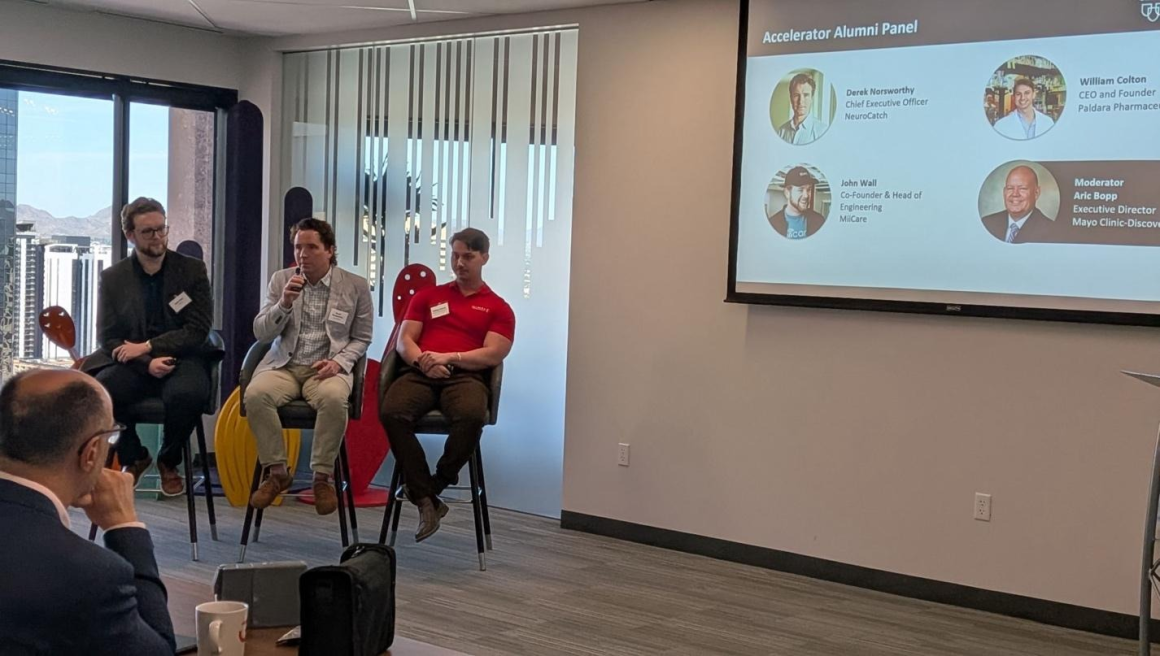
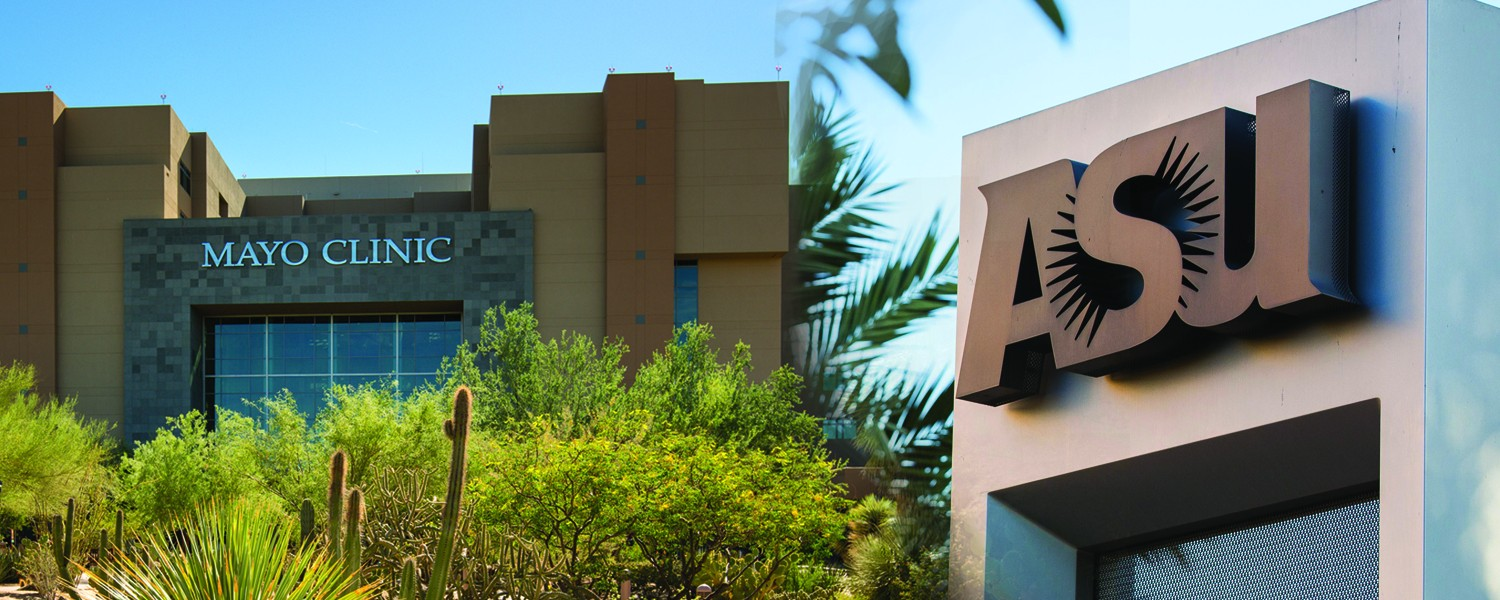
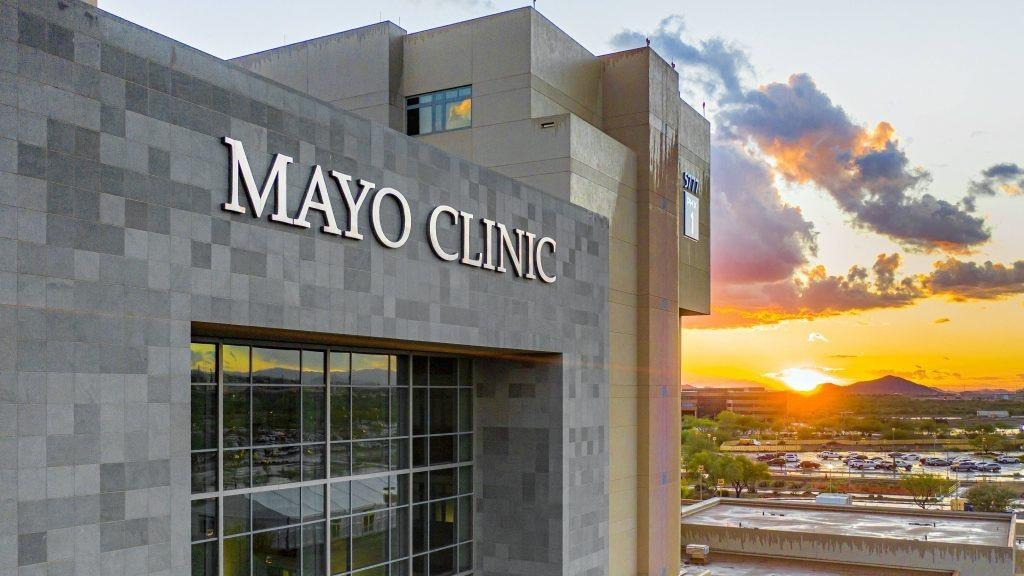
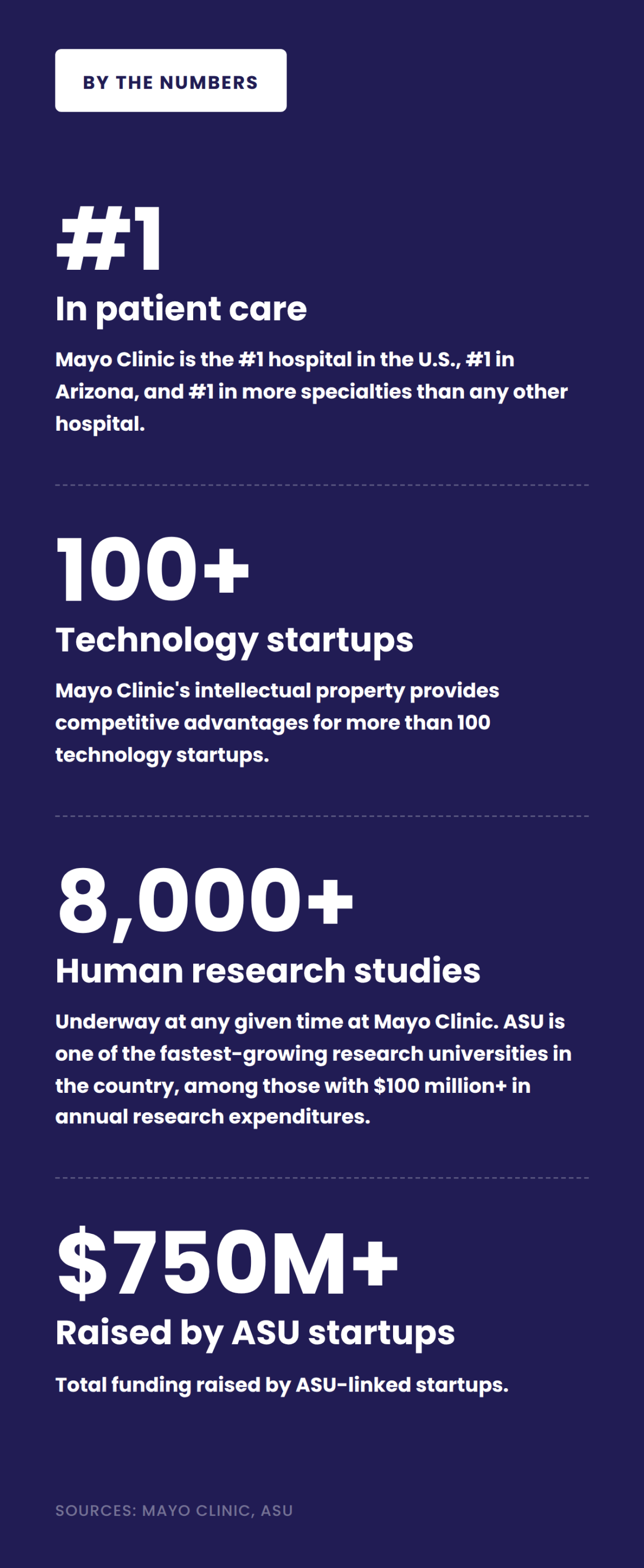
The shift shaping Arizona’s future is unfolding through the partnership between Mayo Clinic and Arizona State University (ASU). The Mayo Clinic campus in north Phoenix and ASU’s Health Futures Center, located next to the campus, have become part of the same conversation about how new health technologies are developed, tested, and brought to market.
Arizona’s future is visible through the Mayo Clinic and ASU Health Care Accelerator. Ten companies from six different countries came to Phoenix this April to take part in the program, almost eight years old now. Caitlin Hiyasat, Program Manager for the Mayo Clinic and ASU Alliance for Health Care, has been in her role for two years and co-leads the partnership with ASU’s Eric Moreno. “Our two organizations complement each other and have collaborated for more than two decades,” Hiyasat says. Moreno said during an interview, “We’re continuing to bring in companies across medical devices, diagnostics, digital health, and life sciences, which reflects how innovation in health care is converging. The biggest shift is the rebrand from MedTech Accelerator to Health Care Accelerator, which better captures the breadth of what we’ve already been doing.” What brought the companies together was more than the chance to pitch. They came because Phoenix is where bold health ideas come to be stress-tested by the demands of real patient care.
For many founders, the appeal lies in the combination of ASU and Mayo Clinic. As Alexander Niculescu, Founder and CEO of MindX Sciences and also Professor and Director at The University of Arizona College of Medicine – Phoenix, explains, “Mayo is the No.1 clinical system in the country, and ASU the No. 1 University for Innovation.” In his view, the partnership offers two things at once: access to ASU’s ability to build digital tools that can be used at a much larger scale and access to Mayo’s expertise in precision medicine. During a talk at The Velocity Summit on April 14, 2026 in Phoenix, Dr. Heather Clark, Director at the ASU’s School of Biological and Health Systems Engineering, said to an audience of healthcare innovators and leaders, “There has been a significant gap between academic AI innovation and real-world clinical implementation.” This program was built to solve that.
Arizona resident Joshua Hanson, Founder and CEO of ImageAiD, describes the combination through his own experience. He grew up in Rochester, where he learned the values of Mayo Clinic, then studied biomedical engineering undergrad at ASU. Hanson will graduate in June as one of seven students from the world’s first biodesign masters program created by Mayo Clinic, ASU, and Stanford University, focused on discovering the methods for developing innovations in medical technology and commercializing them. “Put those two mindsets (ASU and Mayo Clinic) together,” he says, “and you can create a very strong company and leadership presence. It’s jet fuel.”
That “jet fuel” matters because it changes what early-stage companies are able to do. In many innovation hubs, founders move slowly between separate institutions trying to achieve the same benefits of validating their solutions. One group provides research, while another provides clinical access. A third offers funding or business support. Phoenix is compressing those steps.
For Arizona healthpreneurs, clinicians, and hospital leaders, the accelerator is less a competition than a working session. Mayo physicians, ASU researchers, investors, hospital administrators, and founders spend two weeks in direct conversation about whether a technology can survive inside a real healthcare system.
Built for the Hospital, Not the Pitch Deck
The program was designed around a specific frustration. Dr. Steven Lester, the program’s co-founder, watched exceptional innovations get developed and then fail to translate into real-world clinical impact. “The gap was not creativity, it was clinical integration, validation, and trust,” he says. “Too many solutions were being built around healthcare rather than within it. We needed solutions built by providers for providers.”
The accelerator’s clearest lesson is that successful health technologies must fit within existing clinical workflows. As Hanson explains, “Most medtech founders do not understand clinical input is best in the early stage of product development.” The accelerator forces that input to happen early. Founders meet directly with consultants, surgeons, executive health specialists, and purchasing teams. They hear how care is delivered, where technologies fail, and what would need to change for a product to be adopted.
This changes the way products are built. Instead of designing in isolation, founders shape technology around real clinical conditions. Furthermore, Moreno adds, “Are they collaborative, are they open to feedback, and can they take that feedback and translate it into action? This is a very hands-on program, so that mindset is essential.”
A product may impress investors, but still fail inside a hospital. As Hanson notes, “Selling into U.S. health systems is complex – understand the difference between purchasers, users, and payors.” That is why, he argues, “Medical technologies must solve a real problem, enhance workflows, and show evidence of improvements.”
Two Institutions, One Voice
Behind the partnership’s seamless external face is a far less visible internal routine. Hiyasat co-leads the work with Moreno. “The strategy of having co-leaders is to ensure we present a cohesive, unified organization externally, while maintaining strong alignment internally,” Hiyasat says. “It reinforces shared ownership, builds trust across institutions, and allows us to better support our stakeholders through consistency, collaboration, and clear communication.”
That seamlessness was the founders’ intent from day one. Dr. Lester says he and his ASU counterpart, Charlie Lewis, vice president of venture development and physical sciences, set out to build a single, unified core team rather than two cooperating institutions. “The integration is so seamless that often the only way to tell who is from Mayo and who is from ASU is by looking at their badge,” he says. “Our portfolio companies don’t experience two institutions; they experience one coordinated ecosystem. No handoffs, no silos, just aligned expertise.”
That level of regular contact, Moreno says, is what makes the model work. “We all know each other well, and we’ve taken the time to understand and respect how each organization operates. That awareness allows us to come into conversations keeping both institutional priorities and shared goals in mind.” He credits the program’s co-founder, director and chief medical officer, Dr. Steven Lester, with the cleanest articulation of the dynamic: “We all walk and talk the same language.”
For the companies moving through the accelerator, the seams disappear. “From an Accelerator company’s perspective, it often doesn’t feel like they’re interacting with two separate organizations with different goals,” Moreno says. “Instead, our intentional alignment and shared vision is what makes the program run as effectively as it does.”
MindX Sciences Takes Top Honors
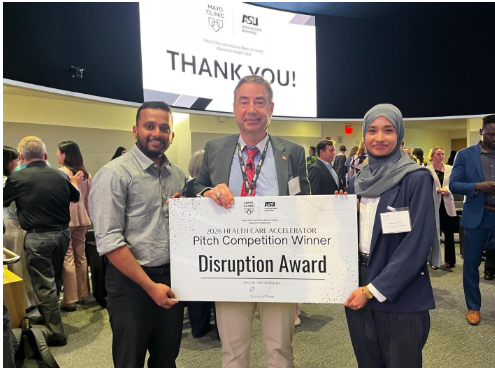
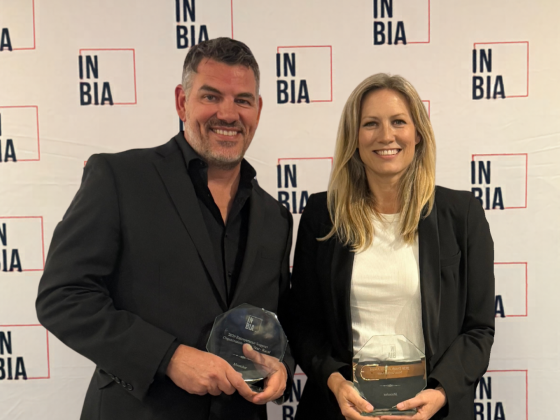
Capping the program, MindX Sciences was named the winner of the Mayo Clinic and ASU Health Care Accelerator pitch competition. With teams in both Arizona and Indiana, the company, founded by Alexander B. Niculescu, MD, PhD, develops precision medicine tools at the intersection of biomedicine and AI, work Niculescu believes “will define the 21st century.”
For Alexander, the draw of the program was straightforward: “They are the best at what they do, we are the best at what we do.” He describes Mayo as “the No. 1 clinical system in the country” and ASU as “the No. 1 university for innovation,” and came to the Valley specifically to explore how MindX could partner with each. Mayo for precision clinical care, ASU for digital tools deployable at population scale.
A key turning point came mid-program, when the MindX team recognized their market was broader than they’d assumed. Rather than staying within the psychiatry niche, they could “work directly with different medical specialties to address the hidden mental health and pain issues that drag down their clinical outcomes.” It’s a reframe that significantly expands the company’s commercial runway. With its Arizona footprint established, MindX is now deepening its roots in the state, with an eye toward longevity research, a natural fit, Alexander notes, for a region where so many come to live their golden years.
The ‘Everything State’ Takes Shape
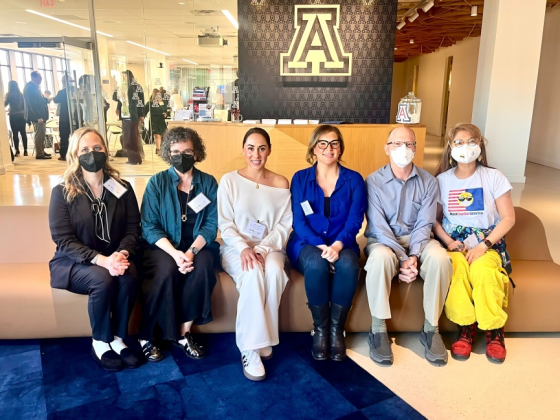
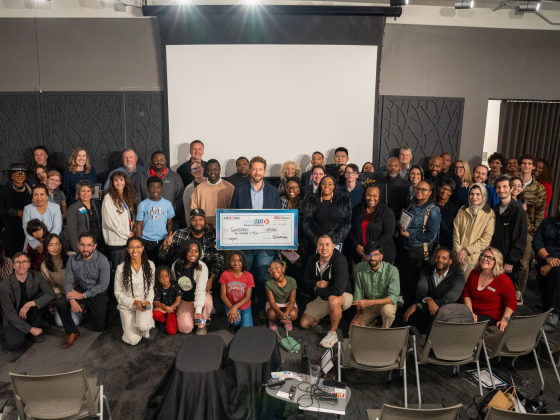
What draws founders to Phoenix’s program is how quickly an idea can be tested against clinical reality. That momentum was visible on the final pitch day on March 25, 2026 at the ASU Health Futures Center. Discussions moved beyond the technology itself to specific questions about reimbursement and workflow.
Founders moved between conversations with clinicians, investors, and university leaders. The presentations were quickly followed by detailed questions from judges about clinical workflow, reimbursement, and how each technology would fit into existing systems. Even at the pitch stage, the discussion had moved beyond the technology itself to whether it could work in practice. The atmosphere felt less like a pitch competition and more like a working session focused on what each company would need in order to move forward.
Phoenix’s emergence as a health care innovation hub is grounded in visible, sustained investment across the region. At the city level, Mayor Kate Gallego has made expanding Phoenix’s bioscience sector a clear policy priority. ASU is continuing to build out its health footprint through ASU Health, while Mayo Clinic has committed to major capital projects through Discovery Oasis and its program expansion called ‘Bold. Forward. Unbound’ in north Phoenix. The industry has followed with Taiwan Semiconductor Manufacturing Company’s multi-billion-dollar Phoenix presence that has reshaped the region’s profile as a destination for advanced research and manufacturing.
That difference is part of why founders increasingly see Phoenix as a place where ideas can move from concept to clinical use without leaving the same ecosystem. Hanson argues that this integration gives Arizona an advantage over established hubs. “A startup would be hard pressed to find another area in the U.S. which has more independent strengths than the Phoenix area,” he says, citing other local support programs and new developments like Discovery Oasis.
For Dr. Lester, that integration is the foundation for something larger. He sees Arizona as uniquely positioned to lead what he calls “the manufacturing of healthcare,” a vision built not just on discovering therapies but on producing them at scale. “The manufacturing of cells, tissues, organs, and advanced devices, and ultimately harnessing and refining the most powerful resource of the next industrial era: data,” he says. While Boston and the Bay Area built world-class biotech hubs over decades, he argues, Arizona has the chance to build something different: “a fully integrated ecosystem that doesn’t just innovate in healthcare but produces it, scales it, and delivers it to the world in an entirely new way.”
Alexander sees a similar “upside,” noting that Phoenix is beginning to operate as a complete ecosystem of universities, hospitals, and infrastructure. “Everything is in place to become the best in the country, perhaps the world,” he says. Moreno also pointed out, “The Phoenix ecosystem is tight knit and very accessible. It’s not as fragmented as some of the larger markets, which means companies can get to the right people faster.” That convergence, universities and hospitals and capital and ambition all in one place, is precisely what makes Arizona not just another innovation hub, but an “everything state” in the truest sense: a place where healthcare founders don’t have to choose between clinical credibility, research excellence, and business support. They get everything right here.
Photo Sources:
- https://www.linkedin.com/showcase/mayo-clinic-arizona-state-university-health-care-accelerator/
- https://www.linkedin.com/posts/greaterphx_bioscience-healthcareinnovation-activity-7440544462302490624-C-utm_source=share&utm_medium=member_desktop&rcm=ACoAAB9zEm8BRnVuLASAbfsQqPhHKMBMTv9qN1g
- https://newsnetwork.mayoclinic.org/discussion/mayo-clinic-and-asu-medtech-accelerator-boosts-health-startups/
- https://news.asu.edu/20210315-arizona-impact-saving-lives-through-innovation-mayo-clinic-asu-accelerator
- Alexander B. Niculescu, MD, PhD

Anisia Corona is a digital health entrepreneur and editor with 27 years of experience in healthcare. She is the founder of DxTx, a health tech company focused on strengthening the provider–patient relationship through AI-powered tools for physicians, such as clinical decision support for complex chronic conditions and conversational AI intake. Anisia also publishes a digital magazine that delivers proprietary and hard-to-find data and insights to clinicians. Anisia is the co-author of studies indexed by the National Institutes of Health and serves as a reviewer and on the Advisory Committee for NIH RECOVER research proposals and studies, as well as grant applications submitted to the United States Department of Defense. Anisia participates in working groups for the Coalition for Health AI (CHAI) as a Patient Advocate, approving best practices for the use of AI in healthcare. She also founded the Arizona Chapter of the AI Collective with a healthcare vertical, creating hands-on AI learning events that advance the use of AI in healthcare across Arizona.
Tanisha Prasad
Tanisha Prasad is an undergraduate student at The University of Queensland majoring in Molecular and Microbial Biotechnology, with a focus on clinical innovation and the commercialisation of biotech. Her background spans laboratory research and science communication, with experience shaped by programs ranging from the Australian Institute for Nuclear Science and Engineering to the San Francisco health-tech ecosystem through UQ Ventures. Currently an intern at DxTx and an assistant in the UQ Translational Biotech Startup Program, she works on early-stage health technologies and the systems needed to bring them into practice.