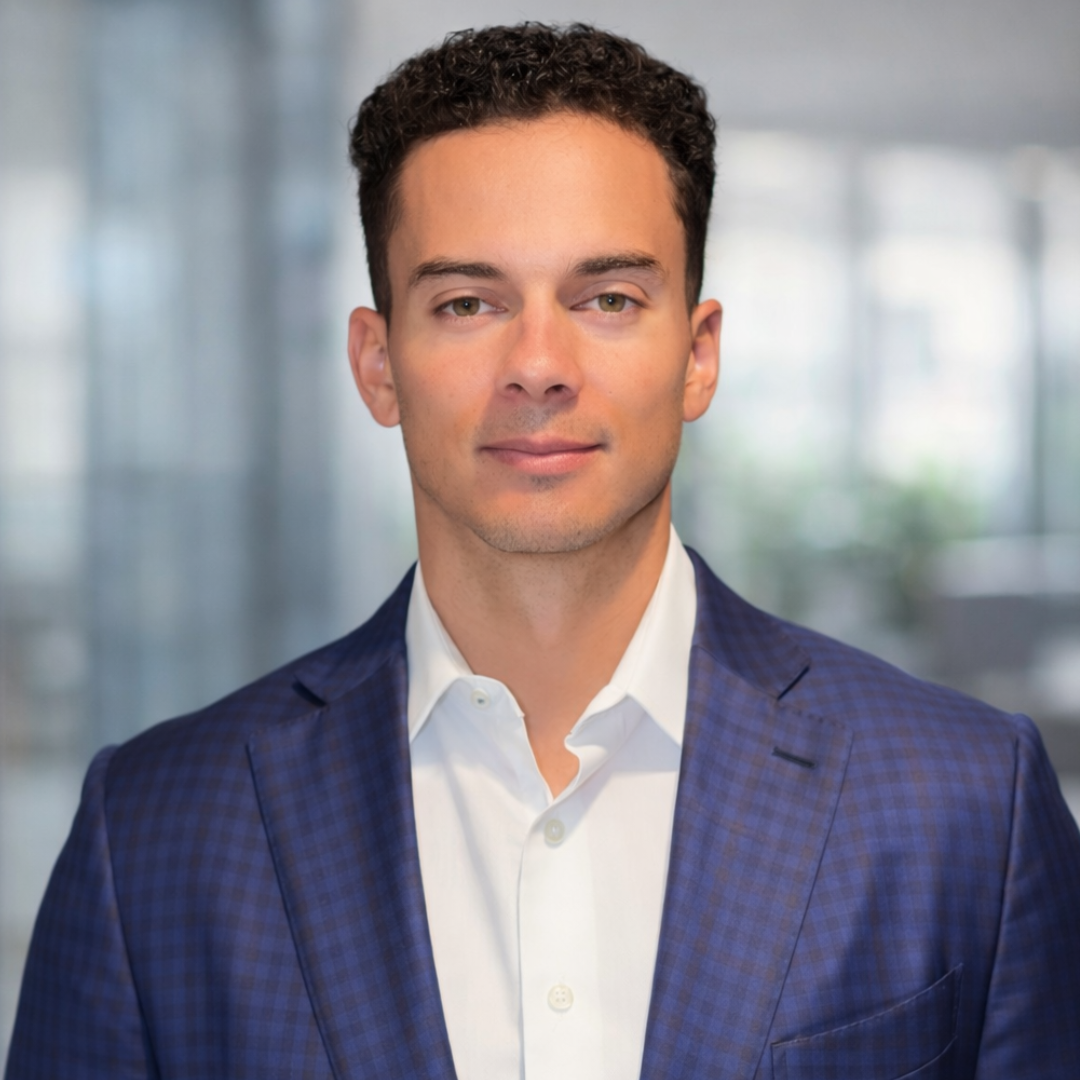
Andre Ramirez
Andre Ramirez is a Partner at Centurion Strategic Advisors, specializing in advanced, tax-efficient strategies. He guides clients through 1031 Exchanges into DSTs, Qualified Opportunity Zones, securitized real estate investments, and business-focused cost-saving solutions. Andre partners with individuals and business owners to reduce tax exposure, preserve capital, and grow long-term wealth through strategic planning and alternative investments. Renowned for his relationship-driven approach, he delivers tailored strategies that align with each client’s unique financial goals.
Why taxes, structure, and planning play a bigger role than most people realize
By Andre Ramirez, Strategic Financial Advisor, Investment Strategies Editor
The Missing Piece in Wealth Building
As we begin this series, the goal is simple. It is to bring clarity to areas of investing and planning that are often overlooked, yet can have a meaningful impact over time.
For many people, building wealth is centered around earning more. That could be through growing a business, investing, real estate, or contributing to retirement plans. But making
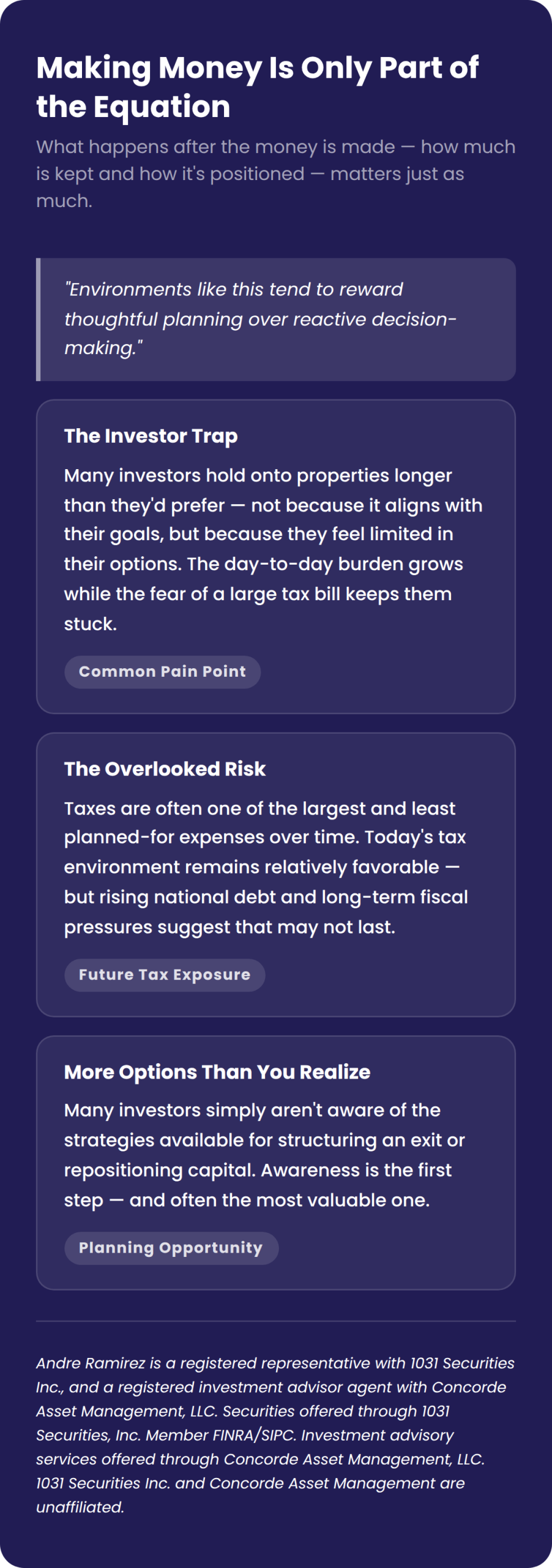
money is only part of the equation. An equally important and often overlooked piece is what happens after the money is made, how much of it is kept, and how it is positioned moving
forward.
Why Investors Feel Stuck and Burned Out
Over time, I have seen a consistent pattern. People work hard, build equity, and create meaningful wealth, particularly through real estate, only to find themselves in a position they did not necessarily intend to be in.
On paper, the investment may look successful. In reality, it often comes with ongoing responsibilities such as maintenance issues, tenant challenges, missed rent payments, and sometimes difficult eviction situations. What was meant to be a path toward more passivei ncome can start to feel increasingly hands-on.
At the same time, when investors begin to consider selling, they are often met with another
challenge, the potential tax implications tied to that decision. So they find themselves in a tough spot. They may no longer want the day-to-day responsibilities, but they also do not want to trigger a large tax bill. As a result, many continue holding onto properties longer than they would prefer, not because it aligns with their goals, but because they feel limited in their options.
The Overlooked Risk: Future Taxation
One of the biggest gaps I see in portfolios today is a lack of protection from future taxation.
While markets and asset values tend to get most of the attention, taxes are often one of the
largest and least planned for expenses over time. From a historical perspective, today’s tax
environment remains relatively favorable, especially when viewed alongside broader economic
trends like rising national debt and long-term fiscal pressures.
While no one can predict exactly where tax policy goes from here, it is reasonable to consider
that tax rates may not remain this favorable indefinitely. Because of that, having at least a portion of a portfolio structured with tax efficiency or partial tax insulation in mind can make a meaningful difference over time, both in terms of returns and long-term purchasing power.
There May Be More Options Than You Think
A big part of the issue is simply awareness. Many investors are not exposed to the range of
strategies that may be available to them when it comes to structuring an exit or repositioning
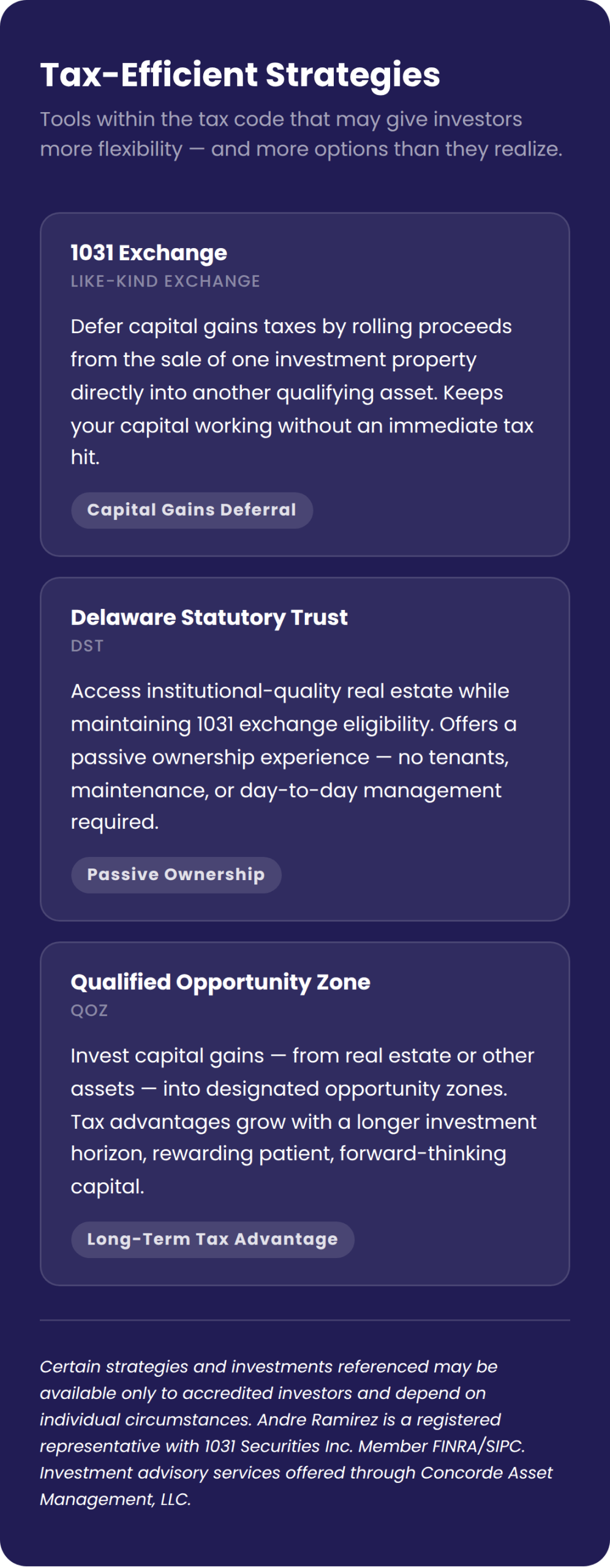
capital in a more tax-efficient way. There are frameworks within the tax code designed to provide that flexibility. A 1031 exchange, for example, allows investors to defer capital gains taxes when transitioning from one investment property into another qualifying asset. However, in many cases, investors may still find themselves actively managing properties.
Structures such as Delaware Statutory Trusts (DSTs) can offer access to institutional-quality real
estate while maintaining the benefits of a 1031 exchange, often with a more passive ownership
experience. Similarly, Qualified Opportunity Zones (QOZs) provide an approach for investors
with capital gains, whether from real estate or other investments, with potential tax advantages
tied to long-term investment horizons. Certain strategies and investments referenced may be available only to accredited investors and depend on individual circumstances, which is why thoughtful planning is key.
Final Thought
In today’s environment, shaped by higher interest rates, slower real estate transaction activity,
and broader economic uncertainty, many investors are understandably hesitant to make a
move. As noted in recent coverage from outlets like the Wall Street Journal and Bloomberg,
elevated borrowing costs and shifting market dynamics continue to influence both investor
behavior and real estate activity. However, environments like this tend to reward thoughtful planning over reactive decision-making. At the end of the day, building wealth is not just about what you earn. It is about how you structure, preserve, and reposition it over time. And often, that starts with understanding that you may have more options than you realize.
Disclosure
Andre Ramirez is a registered representative with 1031 Securities Inc, and a registered investment advisor agent with Concorde Asset Management, LLC. Securities offered through 1031 Securities, Inc. Member FINRA/SIPC. Investment advisory services offered through Concorde Asset Management, LLC. 1031 Securities Inc. and Concorde Asset Management are unaffiliated.