
Jennifer Conrad is the Founder, CEO, and Editor-in-Chief of Arizona Ascent, a media platform more than a magazine—uniting business, real estate, and community across Arizona. She builds brands and content that people remember, turning storytelling into strategy—and strategy into measurable impact.
Under her leadership, Arizona Ascent spotlights the leaders shaping Arizona’s future, positioning their work within the state’s broader momentum. Its stories don’t just inform—they elevate credibility, expand visibility, and connect leaders to the ecosystem that makes growth possible.
Gravitrex began in a garage, guided by lived experience, and now wins awards on the international stage.
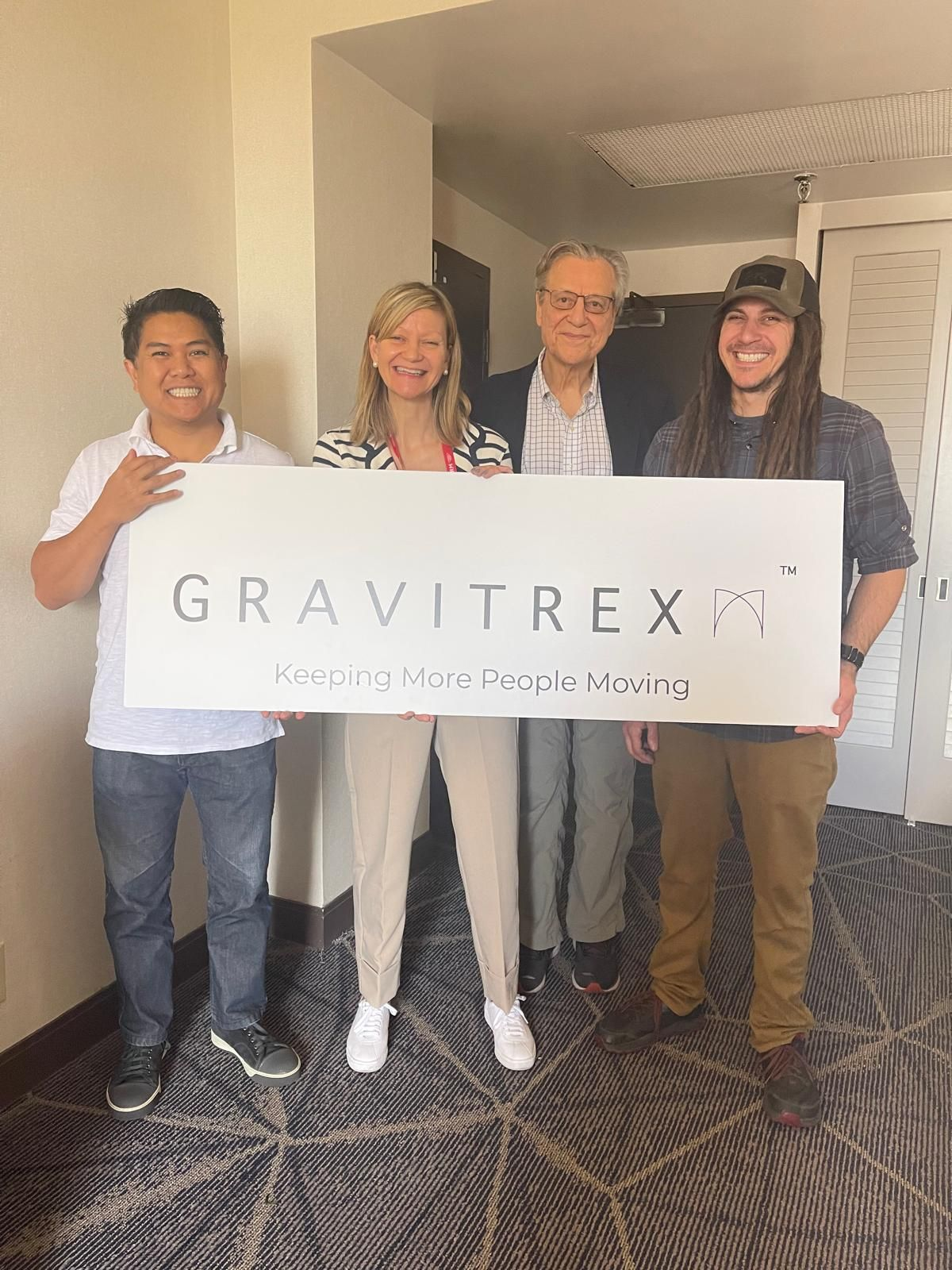
Dr. Richard Burns was just trying to have lunch. It was 2022, an ordinary afternoon in Arizona. He was sitting at a table when, without warning, a car crashed through the wall of the restaurant.
The kind of thing you read about and shake your head at, but this time, it was him. When the dust settled, Richard found himself facing something he had spent a lifetime studying but never imagined experiencing firsthand: he had to learn to walk again.
The cruel irony? Richard is a physician. He had spent decades guiding patients through rehabilitation, watching the slow, humbling, incremental work of recovery. He knew the clinical language, understood the physiology, and now he was living it, gripping a walker and discovering that the tools available to people like him were nowhere near good enough.
“I became the patient,” he says quietly. “And I had the experience on the other side.”.
A Seed Planted Long Before
Richard’s daughter, Kira, had been watching her father for years. Not just since the accident, but long before. She had seen him care for his own mother, Kira’s grandmother, as osteoarthritis slowly stole her ability to move freely. That helplessness — the one that comes from watching someone you love lose the most basic independence — stays with you.
For years Richard and his son Andrew had been turning over an idea: a device that could take meaningful weight off a person’s legs while they relearned to move. Not the ceiling-mounted harnesses that cost a quarter of a million dollars and require a team to install. Not a therapist, a gait belt, and a prayer. Something practical. Something portable. Something that could travel with a patient from hospital to rehab to home.
He and his son, Andrew, a Product Design graduate from ASU, started sketching. Then patenting. Then prototyping in the garage, the way the best Arizona startup stories always seem to begin. And then the accident happened. Suddenly, the abstract became painfully, personally real.
“Even while designing and prototyping,” Richard says, “I ended up needing the very solution I was building.”
Kira had spent years in corporate healthcare, listening to patients describe what mobility really meant. Not convenience. Not comfort. Identity — the feeling of moving through the world under your own power. Watching her father lose that, and fight to regain it with tools she knew were inadequate — made the stakes immediate.
She quit her job. She called her dad. She assembled a team.
This was the moment Kira knew she had to go all in, due to the potential impact. Out of a garage, out of helplessness, and out of a very specific kind of frustration that tends to produce companies worth paying attention to.
How Gravitrex Works
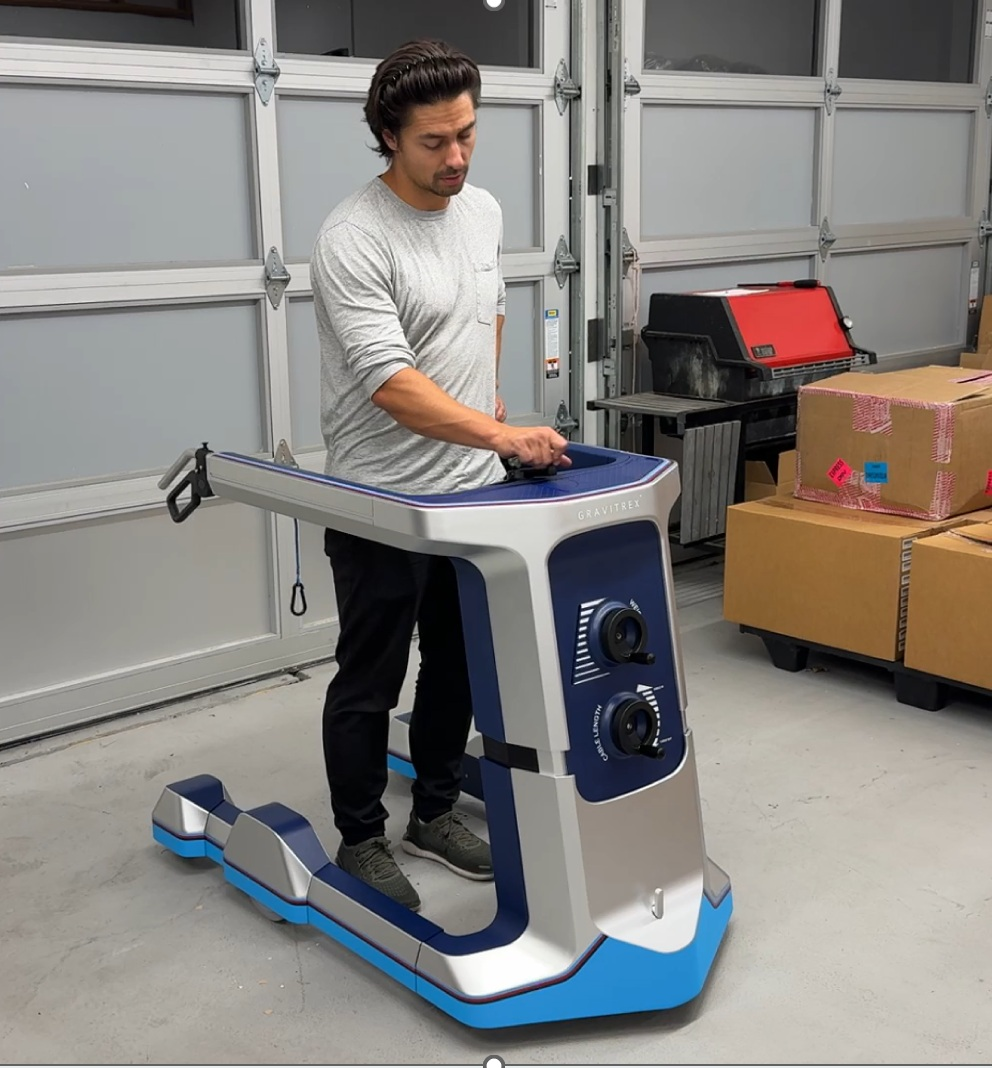
Kira describes it simply: “Think of it like exercise equipment for rehabilitation — except you’re inside it.” Patients step into the Gravitrex device — at first glance, it looks like a specialized walker — and attach to a set of comfortable thigh sleeves. Inside the frame, a patented mechanical system generates a constant lifting force.
No motor. No battery. Just physics, elegantly applied, taking 10 to 100 pounds off a patient’s legs while they walk. For someone outside rehab, that might sound incremental. For someone inside it, it can mean the difference between walking and not walking. Between progressing and stalling. Between going home and staying in a facility.
“Those two transition periods — hospital to rehab, rehab to home — are where people stall,” Richard explains. “Where they drop off in their recovery.”
The Problem
Demographic shifts globally — aging populations, a rising tide of stroke survivors and serious injury recoveries — are creating an enormous and growing need for mobility rehabilitation. Access to specialized care will be central to how well these individuals recover.
At the same time, the US is facing a looming shortage of physical therapists, caregivers, and clinical staff. The system is already under strain, and the math is only getting harder: 13 million older adults (65+) are hospitalized annually. In a single day of bed rest, patients can lose up to 11% of muscle strength. Over 13 million people are discharged each year with a new difficulty in moving — and 1 million of them fall within the year following hospitalization. Meanwhile, 91% of physical therapists sustain a work-related injury during their career.
It’s also worth noting that Gravitrex is not alone in targeting this space. Robotics and exoskeleton companies have been competing here for years, backed by significant capital. But clinical adoption has remained stubbornly limited — high cost and operational complexity have kept these devices out of reach for most facilities.
“Robotics and exoskeleton companies have been in this space for years, backed by strong capital,” Kira says. “But to date, clinical adoption has been limited by the high cost and complexity of these devices. Gravitrex is offering something truly different — a cost-effective, simpler way to help patients get unweighted and fall-safe, so facilities can do more with less staff. That’s why it’s generating so much excitement about its disruptive potential.”
“Those numbers aren’t abstract,” Richard says. “They’re people. Patients, families, therapists. And they’re exactly the challenges Gravitrex was built to solve.”
Built in Arizona
The company got its start through the Arizona Wear Tech Applied Research Center, funded by the Partnership for Economic Innovation, which provided early non-dilutive funding that allowed the hardware startup to survive the brutal stretch between prototype and product. Kira says she was surprised by the state’s collaborative ecosystem.
“Smaller ecosystems have advantages people don’t always see,” she says. “You can move faster. You can find your niche.”
More than funding, Arizona gave Gravitrex something just as valuable: proximity to the people who would actually use the device. From day one, the team was in rooms with physical therapists asking questions, observing, and iterating. The adjustable thigh sleeves, adjustable lifting force, and decision to skip motors all came from listening deeply to these users.
Clinical adoption is the graveyard of many medical startups. Gravitrex was built differently — inside out, with users embedded in the process from the start.
From Phoenix to Tokyo

In February 2026, Kira stood on a stage in Tokyo. More than 1,200 policymakers, investors, and innovators from across the globe were gathered for Venture Café Global Institute’s annual Global Gathering. Eighteen regional startup champions had flown in from North America, Europe, and Asia to compete in the Pitch2Tokyo Grand Final — a World Cup of innovation.
Gravitrex won. Kira took home the Japan Prize, representing Venture Café Phoenix on the largest international stage the organization offers.
Think about that: a company that started in an Arizona garage, built by a daughter watching her father relearn to walk, developed hand-in-hand with local therapists — now recognized as one of the most promising innovations in the world.
“We’re especially honored to receive recognition from Japan,” Kira said, “a global leader in assistive technology.”

Before Tokyo, Gravitrex had already earned accolades from the American Physical Therapy Association’s ALI Shark Tank and the National Institute on Aging Start-Up Challenge.
As part of the Pitch2Tokyo prize, the company now has access to CIC’s global network of workspaces, labs, and innovation campuses — resources unimaginable when Richard and his son were first sketching ideas in the garage.
“Phoenix is building real momentum in biotech,” said Alex Koupal, Event and Experience Director at Venture Café Phoenix. “We’re proud to see leaders like Kira represent the strength of our ecosystem on the global stage: Phoenix to Tokyo.”
What Comes Next
The Gravitrex device today is designed for clinics and rehab facilities. The future Kira is building toward is smaller, connected, and meant for the living room. Remote monitoring lets therapists track gait and adjust care without leaving home.
The market is enormous. Aging populations in Japan, stroke recovery patients in Europe, communities everywhere quietly running out of options for people who simply want to walk again. The Japan Prize wasn’t just recognition. It is a signal that the world is ready for what Gravitrex is building.
Richard Burns is still Chief Science Officer — still the man whose career, accident, and his mother’s knees all converged into this device. Ask him what Gravitrex would have meant during his recovery, and he keeps it simple:
“It would have made practicing walking easier.”
And that’s it. A physician who became a patient. A daughter who turned helplessness into a company. A garage in Arizona that somehow became a stage in Tokyo. All in service of making something that was hard a little bit easier for the people who need it most.