Arizona added nearly 100,000 residents in a single year. What matters now isn’t momentum, it’s whether the systems underneath can hold.
For a long time, Arizona’s growth felt optional. People arrived, but the state still had room to stretch. Roads absorbed traffic. Employers absorbed talent. Housing absorbed demand, even when prices moved quickly. Growth was visible, but it didn’t require recalibration.
Somewhere in the past year, that feeling changed. Not abruptly. Quietly. Commutes lengthened. Hiring timelines stretched just enough to register. Schools filled faster than expected. Housing conversations shifted tone. Growth didn’t stop, it settled in.
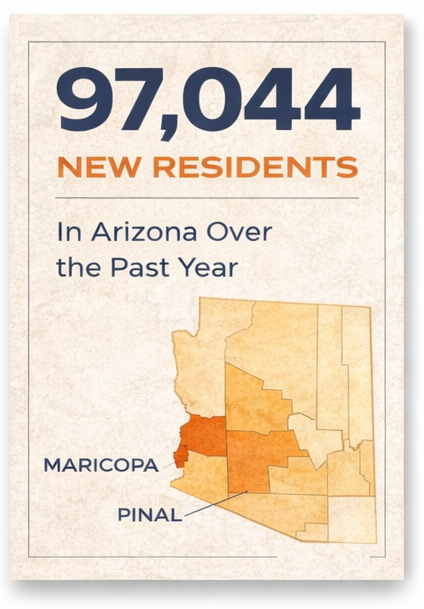
Between July 1, 2024, and July 1, 2025, Arizona added 97,044 residents. That averages out to roughly 266 new people every day. At that scale, growth stops being a headline and starts becoming a condition. This is the moment after arrival.
Where the Weight Settles
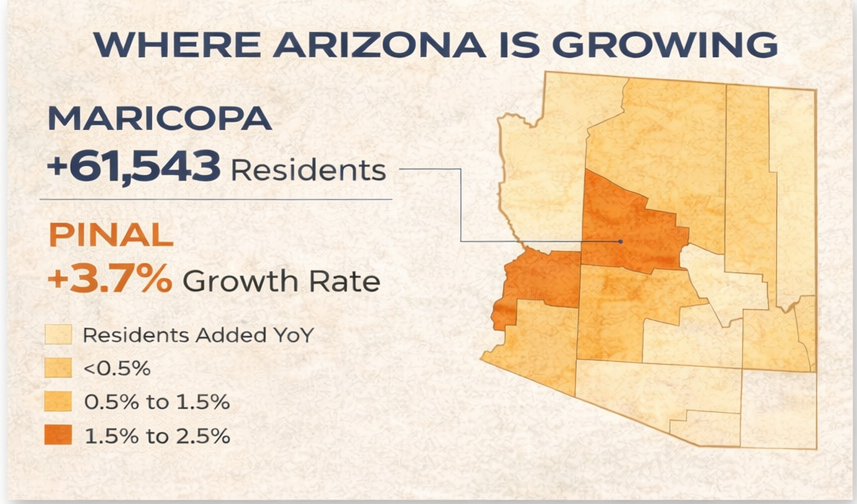
The headline number matters, but distribution tells the real story. Maricopa County absorbed more than 61,000 new residents in a single year, reinforcing its role as the state’s gravitational center. Pinal County followed with more than 18,000 new residents, posting the fastest growth rate statewide at 3.7 percent. That pattern isn’t accidental.
Growth is stretching outward along affordability corridors, logistics routes, and employment access points. Pinal’s rise reflects housing spillover and industrial expansion, not a departure from the metro core. Yuma, Mohave, and Santa Cruz counties show similar dynamics at smaller scale growth driven by access, cost, and connectivity rather than speculation. This isn’t decentralization. It’s pressure redistribution.
The First Places to Feel It
At the city level, the shift becomes tangible. Phoenix added nearly 12,000 residents in a year. Surprise, Buckeye, Goodyear, Maricopa, Glendale, Mesa, and Marana all posted gains that follow the same pattern: people arriving faster than systems were originally designed to handle. The effects are subtle but cumulative.
A hiring manager notices candidate pipelines taking longer to fill. A school district revises enrollment projections mid-year. A city planner recalculates infrastructure timelines that once felt comfortably distant.
None of it is dramatic on its own. Together, it signals a change in posture. Growth here isn’t loud. It’s constant.
And constant growth is heavier than sudden spikes. It touches everything at once.
Absorption Is the Signal
Population growth without job absorption is fragile. This isn’t that. Arizona has recorded nine consecutive months of labor force growth. Employment gains are tracking alongside population increases rather than lagging them. The state’s unemployment rate remains below the national average not because growth has slowed, but because the economy is pulling people into payrolls instead of leaving them idle.
In many fast-growing regions, population leads and employment scrambles to catch up. In Arizona, the two are increasingly moving together. Health care, professional services, leisure and hospitality, and financial activities continue to expand not explosively, but steadily enough to anchor demand.
After the Influx
Since 2011, Arizona has added nearly 1.3 million residents roughly 20 percent growth in just over a decade. That context matters. Growth didn’t arrive all at once. What feels different now isn’t the pace. It’s the posture.
Earlier waves of migration were fueled by urgency. Pandemic relocations, housing arbitrage, and lifestyle resets.
Today’s growth is more deliberate. People aren’t just arriving. They’re staying. Working. Enrolling kids in schools. Starting companies. Signing longer leases.
That shift places a different kind of demand on the state. Not just to attract, but to coordinate.
What Growth Demands Next
Arizona’s challenge is no longer visibility. It’s coherence. Housing markets are settling rather than surging. Businesses are choosing to grow in place instead of moving on. Marketing, education, and infrastructure are quietly becoming more systematized.
Population growth fits inside the same pattern. The question ahead isn’t whether Arizona can grow. It’s whether it can absorb growth without losing alignment, between housing and wages, people and payrolls, speed and stability.
This is what maturation looks like. Not the end of momentum, but its transformation into something heavier, slower, and more durable. Growth happened. What comes next is capacity