
Jennifer Conrad is the Founder, CEO, and Editor-in-Chief of Arizona Ascent, a media platform more than a magazine—uniting business, real estate, and community across Arizona. She builds brands and content that people remember, turning storytelling into strategy—and strategy into measurable impact.
Under her leadership, Arizona Ascent spotlights the leaders shaping Arizona’s future, positioning their work within the state’s broader momentum. Its stories don’t just inform—they elevate credibility, expand visibility, and connect leaders to the ecosystem that makes growth possible.
How Phoenix Valley’s housing market is recalibrating—and what it means for the people shaping Arizona’s future.
It’s mid-January in the Valley, and the open house is quiet. In Buckeye, a young family walks through a new subdivision, noticing more “For Sale” signs than they remember from last year. Builders move between lots with measuring tapes and clipboards, aware that buyers now have choices. For months, the Valley’s housing market had raced—bidding wars, waived contingencies, offers over list price—but now, the rhythm has shifted.
A headline in early January from AZFamily framed the Valley in a single sentence: buyers finally have leverage. More homes.
Fewer fights over one listing. Prices softening. And longer days on market. For anyone building, buying, or investing in Arizona, the question lingered: Is this just a pause—or the start of a broader recalibration?
Arizona Ascent took a closer look. Drawing from the January 24, 2026 Fidelity National Title Agency Market Reports—sourced from ARMLS and Altos Research—we examined the market city by city. The answer is clear: the market is finding a new balance, but that balance looks different depending on where you are.
West Valley
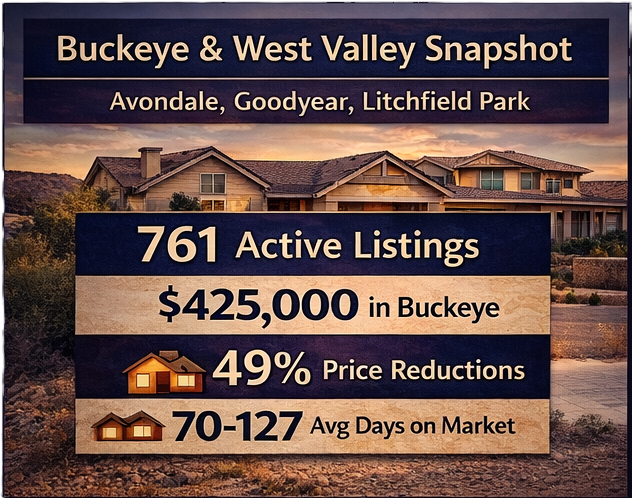
In Buckeye, median list prices sit around $425,000. The city’s 761 active listings reflect rapid development and a growing population. Here, buyers stroll through new neighborhoods with confidence. They are no longer competing with dozens of others for a single lot. Price reductions, now reaching 49% of listings, give them leverage the frenzy never allowed.
Nearby Avondale, Goodyear, and Litchfield Park echo the story: supply is ample, options are varied, and families can weigh multiple properties before deciding. In these corners of the Valley, the AZFamily snapshot holds up. More inventory equals more choice, and Arizona Ascent confirms it—buyers can take their time.
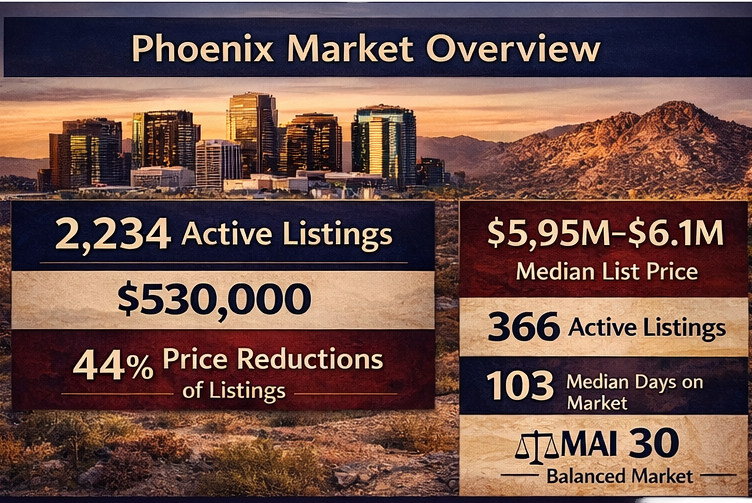
Phoenix itself presents a different rhythm. With over 2,200 active listings, the city has the largest volume in the metro.
Median prices hover near $530,000, offering a mid-range benchmark. Yet the story here isn’t scarcity—it’s selectivity. Extended days on market—averaging 70–127 days across neighborhoods—allow buyers to consider each property carefully.
Nearly 44% of Phoenix listings have undergone price reductions, a subtle but important shift. Sellers are no longer testing the market with inflated asks; they are adjusting, recognizing that patience now defines success.
Scottsdale and Paradise Valley
Scottsdale’s 1,441 active listings tell a story of abundance in a market that once felt constricted. Median days on market have stretched to 84, and price reductions are common. Buyers can negotiate without losing the quality or prestige they expect.
Paradise Valley remains the Valley’s ultra-luxury anchor, with homes listed from $5.95 million to $6.1 million. Here, the Market Action Index hovers near balance, signaling that sellers still hold some power.
Southeast Valley
Queen Creek, with 362 active listings and medians between $612,000 and $670,000, typifies the growing Southeast corridor. Builders continue expanding, but homes linger longer than before, giving buyers the rare luxury of comparison. Nearby Gilbert, Chandler, and Mesa mirror this pattern: prices remain steady, but listings move at a deliberate pace. Buyers here are empowered; sellers must adjust incentives and pricing to close deals.
North Valley & Foothills
In Carefree, Cave Creek, and Fountain Hills, listings are fewer but timelines are longer. The Market Action Index shows some areas tilting toward buyers, while others like Paradise Valley remain balanced. It’s here that the Valley’s diverse dynamics become most apparent: geographic prestige still carries weight, but time has returned as a lever.
Buyers can choose, negotiate, and plan something unthinkable in the peak frenzy years.
The Market in Context
Across the Phoenix metro, the numbers tell a coherent story:
- Inventory: Rising city by city; Valley-wide total aligns with AZFamily’s 22,000 homes.
- Prices: Stable but adjusting; reductions affect 38–49% of listings.
- Days on Market: Lengthened significantly; buyers have time to evaluate.
- Market Action Index: Slight seller advantage overall, but pockets of balance and buyer-friendly conditions now exist.
Arizona Ascent’s analysis confirms AZFamily’s headline—but adds nuance. Supply growth, longer timelines, and increased concessions are not uniform. Each city tells a slightly different story, reflecting local growth patterns, affordability, and lifestyle appeal.The Valley’s housing market is not collapsing—it’s maturing. Buyers regain leverage; sellers adapt.