
Jennifer Conrad is the Founder, CEO, and Editor-in-Chief of Arizona Ascent, a media platform more than a magazine—uniting business, real estate, and community across Arizona. She builds brands and content that people remember, turning storytelling into strategy—and strategy into measurable impact.
Under her leadership, Arizona Ascent spotlights the leaders shaping Arizona’s future, positioning their work within the state’s broader momentum. Its stories don’t just inform—they elevate credibility, expand visibility, and connect leaders to the ecosystem that makes growth possible.
By Jennifer Conrad, Managing Editor
Six weeks ago, a group of Arizona founders walked into Loloft with laptops under their arms and big ideas in their heads. They didn’t come for comfort—they came for pressure.
Hosted by Silicon Oasis and Devlabs, Arizona’s first hacker house program wasn’t about living under one roof. It was about building under one roof. Loloft’s warehouse-style coworking space became a launchpad where days started early, nights stretched long, and whiteboards filled with sketches of products that didn’t exist yet. Code was written, scrapped, and rewritten. Mentors dropped in to sharpen pitches, challenge assumptions, and sometimes tear ideas apart so better ones could emerge.
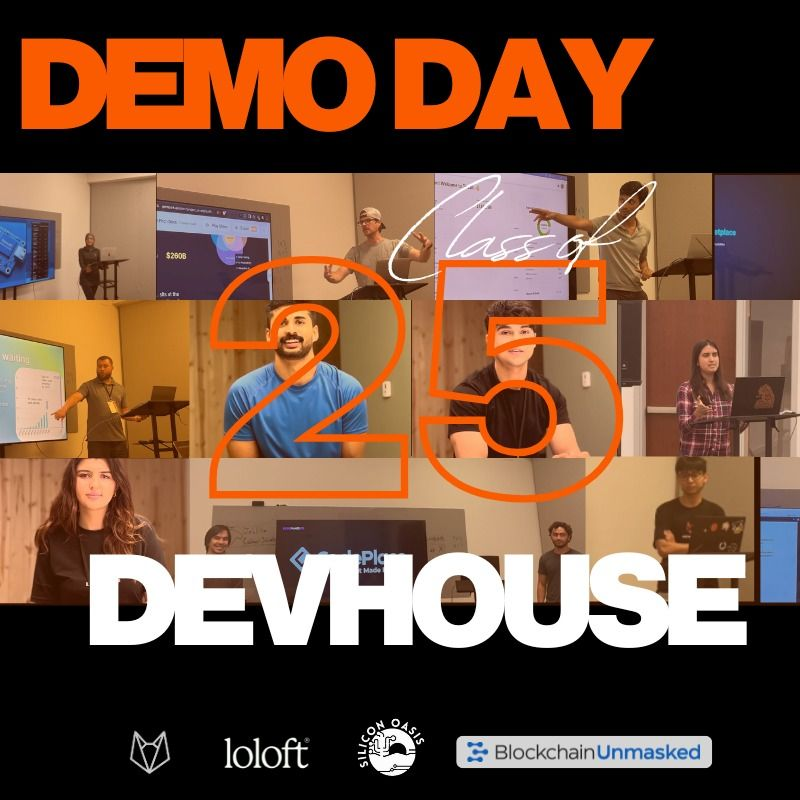
Eight startups. Twelve builders. Countless late nights. That intensity became the rhythm of DevHouse 2025, a first-of-its-kind sprint backed by PHX Ventures, AZ-VC, and the Arizona Commerce Authority and fueled by sponsors like BlockchainUnmasked, Novel Ice Cream, and the team at Loloft.
The bet was simple: put ambitious people in the same space with the right structure, and something extraordinary will happen.
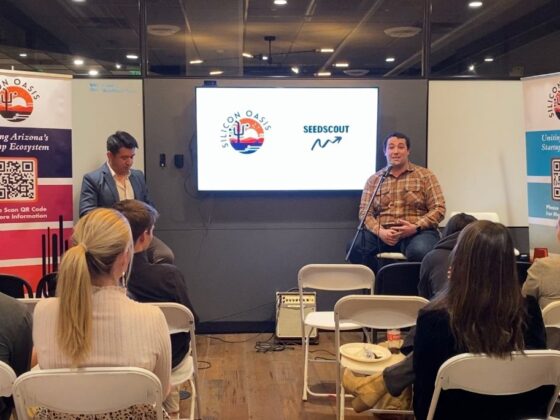
On Demo Day, the bet paid off. Investors, VCs, and seasoned founders who’ve raised millions packed the room shoulder-to-shoulder, the chatter blending with the hum of last-minute pitch tweaks. When certificates were handed to the Class of ’25, it wasn’t just a graduation, it was proof that Arizona’s startup scene could stand shoulder-to-shoulder with bigger hubs.
Reinventing Everyday Industries
The first pitch to land made it clear that DevHouse wasn’t about flashy gimmicks—it was about solving real problems in industries most people never think twice about.

Mark, cofounder of BINsr AI, stood with the quiet confidence of someone who knew his wedge into the market was undeniable. Home inspections aren’t glamorous, but they’re essential and they haven’t changed much in decades. Reports take hours to compile, inspectors spend as much time typing as they do look, and homeowners often wait until nightfall for results.
BINsr AI flips that script. By embedding artificial intelligence directly into the workflow, the platform cuts documentation time in half. Inspectors can snap photos of defects, and the system suggests relevant comments on the spot. Voice recognition captures observations even in noisy environments, and cross-device syncing means a report can be generated before the inspector leaves the driveway. Add scheduling, payments, and even optional marketing tools, and you get a one-stop shop that saves inspectors from hours of after-work drudgery.
What used to take three hours now takes 90 minutes. Forty-seven inspectors are already on the waitlist, and with a 40% cold outbound conversion rate, adoption looks less like a question and more like inevitability. In a room full of VCs, BINsr AI proved that even in the most traditional industries, speed and intelligence win.
When Science Meets Urgency
If BINsr AI showed the power of efficiency, CETARA showed the weight of urgency. Their mission: tackling PFAS, the so-called “forever chemicals” linked to cancer, infertility, and immune disorders. With EPA mandates kicking in by 2026, municipalities need solutions fast—but the science is scattered across countless studies, often hidden behind paywalls.
CETARA pulls that research into the light. Their AI-driven platform centralizes peer-reviewed PFAS filtration data and turns it into actionable insights for engineers, water utilities, and municipalities. The system not only points to the most effective treatment strategies it provides citations for full transparency.
Co-founders Mary Sannapu and Eleazar Ripsam, both from ASU, have built a team that blends academic depth with entrepreneurial drive. With PhD researchers Shinyun Park and Yanji Tian, plus guidance from faculty advisor Dr. Tiezheng Tong, they bring rigor and credibility to a problem that demands both.
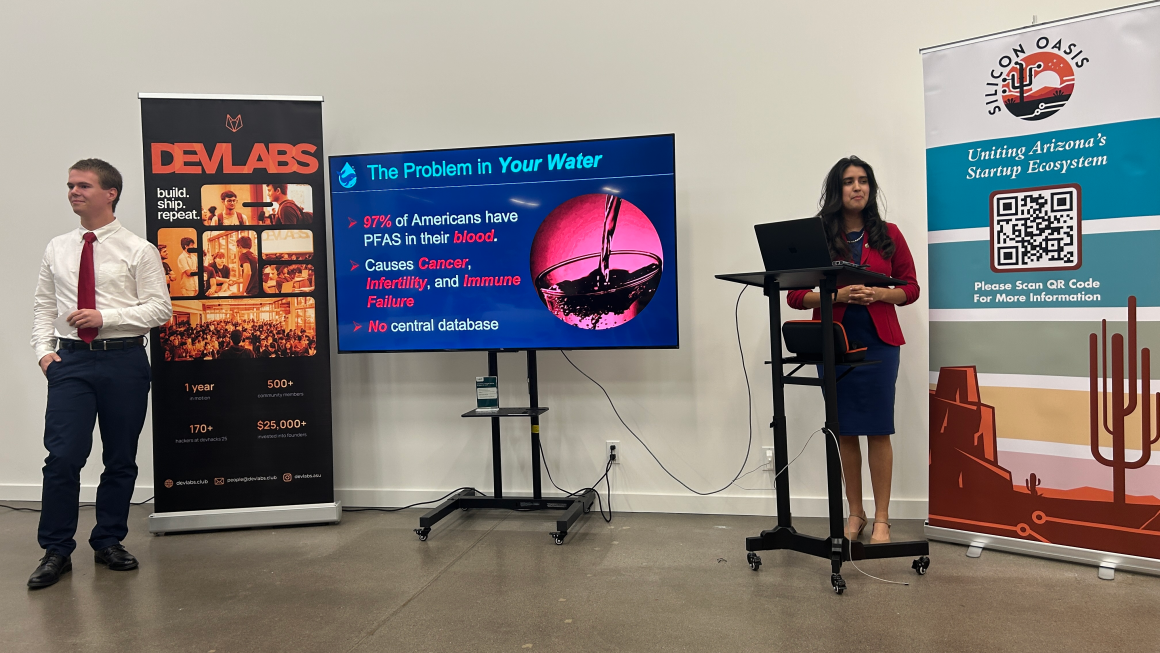
Already used in ASU’s TALM Research Group and headed to major international conferences, CETARA’s platform is more than theory. On stage, their pitch carried urgency that resonated: solving PFAS isn’t just about compliance, it’s about health, safety, and the future of clean water.
Hospitality, Reimagined
From water to homes to restaurants, the night’s themes kept circling back to a common thread: making human systems work better. No one embodied that more than Obotiq, a Tempe-based robotics company asking a simple question: what if robots felt like teammates instead of tools?
“Hospitality has always been about the human experience,” the team told the audience. “Our role is to create technology that protects that experience while making operations more efficient.”

Their machines don’t shuffle around like stiff, soulless automata. They glide with intention, greet guests, answer simple questions, and deliver meals with a presence that feels welcoming rather than mechanical.
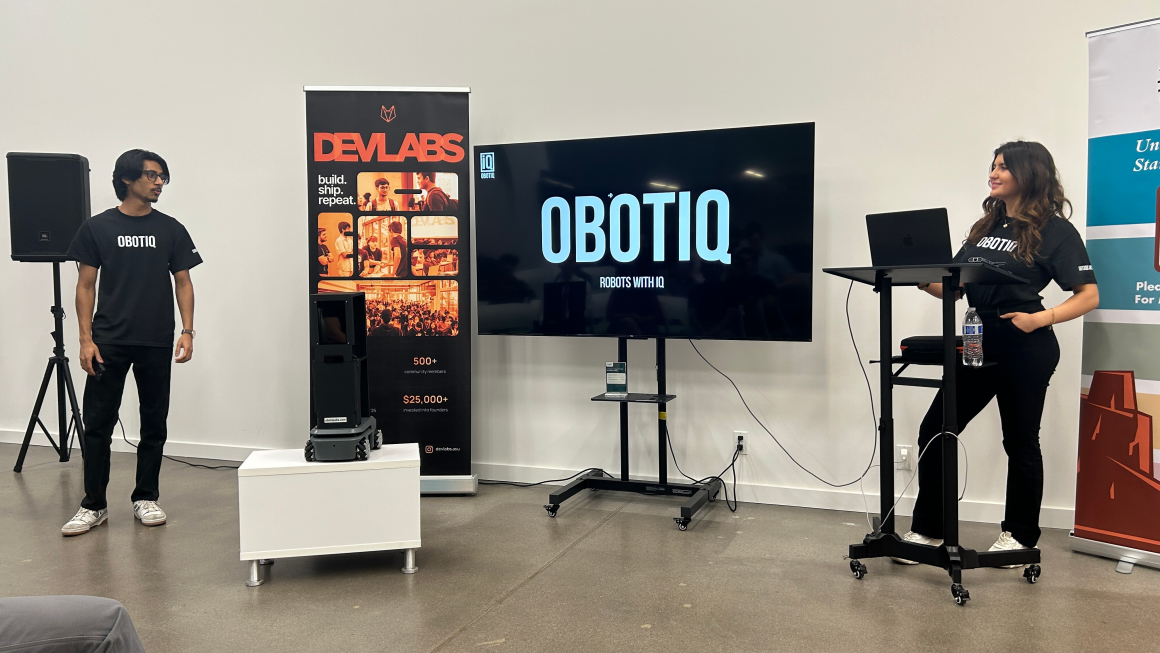
At the heart of their vision is Flux, a sleek black, three-shelf service robot topped with a touchscreen interface. Beyond its polished design, Flux is built for connection. It weaves through crowded dining rooms with ease, adapts to different floor layouts, and speaks multiple languages. For staff, it handles repetitive tasks like food running and waitlist coordination. For diners, it feels futuristic yet approachable, an unexpected partner in the service experience.
The numbers add punch to the pitch: each unit could save restaurants over $14,000 per month in labor costs, all while improving guest satisfaction. Already crowned winner of ASU’s top startup competition, Obotiq used Demo Day to prove that automation doesn’t have to mean less humanity. With Flux, they showed the opposite, technology that enhances warmth by taking care of the grind.
The Energy Behind the Builders
While BINsr AI, CETARA, and Obotiq took the spotlight, the real story was in the air: six weeks of relentless focus culminating in a single night. Mentors, peers, and founders pushed one another through late-night sprints and early-morning standups. Eight startups. Twelve builders. One room full of proof that structure plus hustle equals breakthroughs.
The ecosystem showed up, too:
- Silicon Oasis co-founders Josue Romero and Kyle Macdonald, guiding the program from day one
- David Richards (BlockchainUnmasked), backing the vision
- Brendan Howell (Loloft), providing the perfect space
- Novel Ice Cream & Shawn Allard, keeping spirits high as Dessert Sponsor
Handing certificates to the Class of ’25 wasn’t just symbolic—it was a statement: Arizona can grow its own startups. Arizona can build big.
More Than a Demo Day
By the time the last pitch wrapped, it was obvious: this wasn’t just a demo—it was ignition. BINsr AI, CETARA, and Obotiq left the stage with more than applause. They walked out with investor cards in their pockets, follow-up meetings lined up, and momentum that only comes from showing, not telling.
Class of ’25, you didn’t just demo. You made history.









1 comment
Hi theere everyone, it’s mmy firsxt goo too seee at thiss site, annd pos iss in fact fruitfl desiigned forr me, keep upp psting
thes typpes oof articles.
Also viusit mmy page; porn2021.biz